Flying from the UAE with a Powered Wheelchair or Mobility Scooter
Quick answer
Contact the airline operating each flight as early as you can, and at least 48 hours before departure where the airline asks for that. Have your device’s size, weight and exact battery type ready, and get approval in writing. Battery rules depend on the battery type, and on whether it stays installed or is removed. No single watt-hour figure covers every wheelchair, so ask the airline to confirm your exact device.
How this guide was made: We read airline pages, conditions and manufacturer documents on 3 November 2026. Rules change, and some airline pages leave out details. IonicRide has not tested these journeys. This guide is about mobility aids for people with restricted mobility. Leisure rideables, such as hoverboards, are treated differently and are often forbidden.
Airline requirements compared
On a phone, swipe sideways to see every column. “Not stated” means we did not find it on the pages we read.
| Airline | Notice | Size and weight | What they say to do |
|---|---|---|---|
| flydubai | 48 hours for a battery-powered aid. Arrive 3 hours before departure | 124 x 114 x 80 cm, upright and folded. 100 kg; heavier needs prior approval | Complete the Wheelchair and Mobility Aid form. Call +971 600 54 44 45, or visit a Travel Shop |
| Etihad | Etihad says to contact it “up to 48 hours” before the flight. Ask early | Up to 120 cm high and 60 kg. Larger may need approval | Prior approval is required for battery-powered chairs. Use contact centres, chat or WhatsApp |
| Emirates | 48 hours by phone. Tell Emirates early. Arrive 3 hours ahead | Lists cargo door sizes by aircraft. No weight limit stated, but it needs the weight | Give battery type, size and weight. Contact your local office before travel |
| Air Arabia | Conditions mention 48 hours’ advance warning for electric wheelchairs | Over 60 kg needs airline approval. Size not stated | Advise staff on arrival, and contact the airline before travel |
Aircraft can change, and smaller aircraft may have tighter limits. A Permobil manual copy warns of this, so ask about each aircraft on your route.
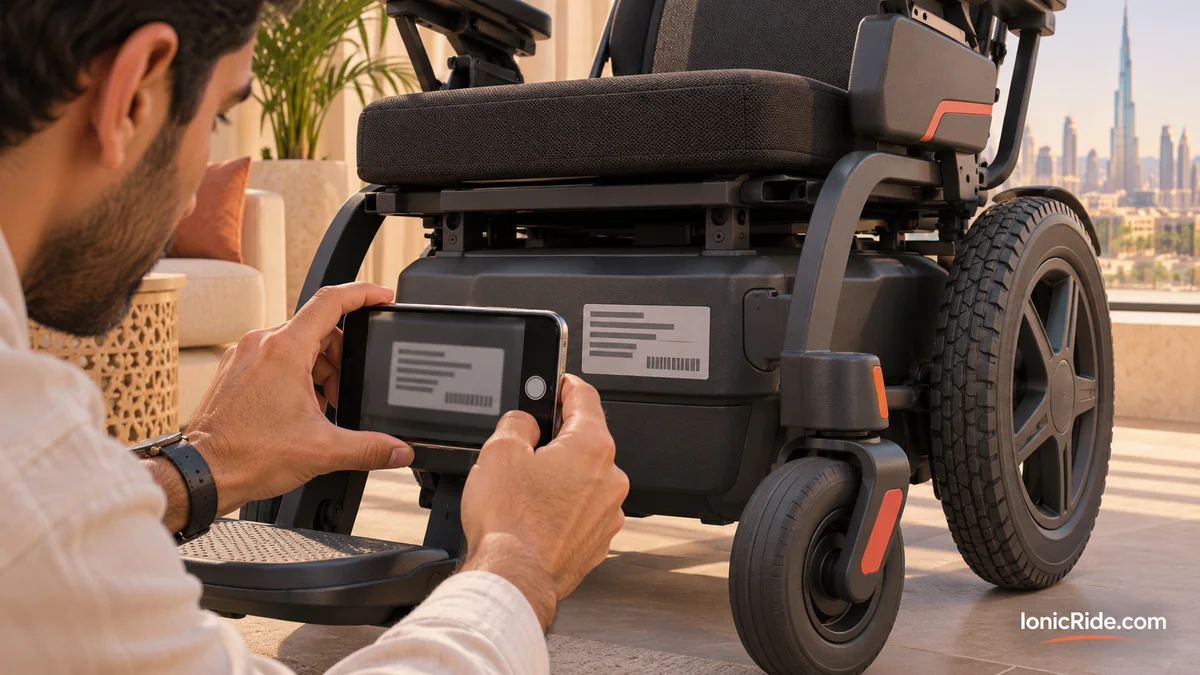
Know your battery
Find the type and rating from the battery label and your manual, and send a photo to the airline. Do not guess.
| Battery set-up | What flydubai’s dangerous goods page says |
|---|---|
| Non-spillable wet battery | Must meet IATA Special Provision A67, with terminals protected from short circuit. One spare allowed. Removed and spare batteries must be in strong, rigid packaging and carried as checked baggage |
| Spillable battery | The aid is accepted only with conditions, and batteries removed from the device will not be transported. Ask flydubai before booking |
| Nickel-metal hydride or dry battery | Two spares allowed, meeting the listed provisions |
| Lithium-ion, removed | Remove it following the maker’s instructions, and carry it in the cabin. Each removed battery up to 300 Wh. On collapsible aids with two batteries, each up to 160 Wh. Must meet UN 38.3 tests |
| Lithium-ion, staying installed | No Wh limit stated on this page, while the assistance page gives Wh limits. Ask flydubai to confirm for your device |
| Lithium-ion spares | One up to 300 Wh, or two up to 160 Wh each, in a protective pouch, in hand baggage |
All are marked as “subject to approval”. This is one airline’s wording. We did not find equivalent battery tables for Emirates, Etihad or Air Arabia on the pages we read, so ask them directly. Etihad’s general dangerous goods guide has no wheelchair battery entry, and its general limits for spare batteries are not a wheelchair approval.
Hong Kong’s Civil Aviation Department guidance, based on international rules, also says removed and spare lithium batteries go in the cabin, with protected terminals. It is useful context, but your airline decides.
Do not assume “up to 300 Wh” means allowed
Battery type, whether it can be removed, terminals, packaging and the airline’s approval all count. Only remove a battery if your manual says it can be removed. Do not open a battery pack, or use tape in a way your manual or airline does not allow.
Protecting the battery and preventing activation
flydubai says batteries must be undamaged and not leaking. Disconnected batteries go in a leak-tight box, normally supplied with the wheelchair, and flydubai will not package them for you. The chair must be protected so that it cannot switch on during the flight.
The Permobil manual copy says that gel batteries usually stay in the chair with cables disconnected and terminals insulated, and warns that some airlines may refuse acid batteries. That is for that chair. Follow your own maker’s instructions. If they differ from your airline’s rules, ask both before you travel.
Connections and other airlines
- Each operating airline counts: confirm every flight with the airline that actually operates it.
- Partner flights: flydubai says you must tell a partner airline and provide proof that it will accept the wheelchair, or it won’t be carried.
- Transit: flydubai says wheelchairs are not collected at transit or stopover airports. Ask how you will move between flights.
- Your destination: ask about the arrival airport, and how the device will reach you.
Book assistance separately
Approval for your device is not the same as help at the airport. flydubai says to ask for wheelchair assistance at least 24 hours before departure and before online check-in. Emirates says to submit a medical form (MEDIF) no later than 48 hours before your flight, when you need one. Air Arabia’s conditions may also require medical clearance in some cases, so ask.
Ask where you will hand over your device. Emirates says you transfer to an onboard wheelchair for boarding, and your own wheelchair goes in the hold. flydubai says at most airports you can take it to the gate, and it comes back in the baggage hall. Etihad says it may return it on arrival, or at the aircraft door where available. Ask how long you may be without it.
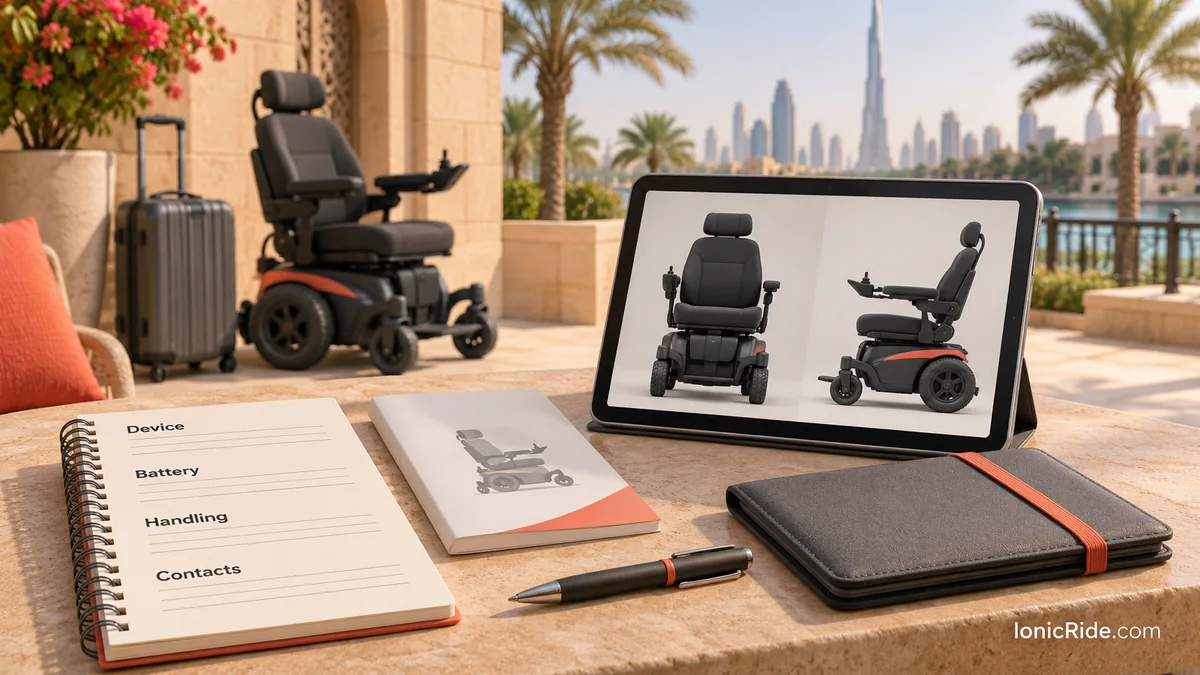
Written handover checklist
Print or save this in English and Arabic, if you can. Permobil’s travel checklist suggests a written sheet for ramp staff, and tags with your contact details.
- ☐ Approval emails, booking reference and all flight numbers
- ☐ Device brand, model, size and weight, with folded size if relevant
- ☐ Battery type, Wh rating and label photo
- ☐ Whether the battery stays in or is removed, with the manual’s page
- ☐ How to power off and prevent activation
- ☐ How to engage freewheel to push the chair, and when not to, from your manual
- ☐ Lifting points, and parts that must not be lifted
- ☐ Removable parts and how to protect the joystick
- ☐ Your contact details, tagged on the chair and parts
- ☐ Photos of the device from all sides before handover
- ☐ Any medical documents the airline asks for
Permobil suggests tucking the joystick to the inside of the armrest, and says some airlines may ask for a waiver. Read any form before you sign it. Emirates says it checks your wheelchair at check-in to record any existing damage, so note any damage there.
If the device is refused or damaged
- Ask for the reason in writing, and show your approval.
- Report damage before you leave the airport, with photos.
- Do not use the device if the controls, brakes or battery seem damaged. Contact the supplier.
- Keep receipts, and ask the airline about its claims process.
Before you fly, ask your supplier for a nearby service contact at your destination. If you are choosing a device, our guides to electric wheelchairs and mobility scooters can help you compare. Check a travel-friendly claim against the airline’s own limits.
FAQs
Does a mobility scooter count as a mobility aid?
flydubai’s ban on small electric vehicles says it does not apply to mobility aids for people with reduced mobility, and says it carries battery-powered wheelchairs only for passengers with restricted mobility. Tell the airline your need, and ask it to confirm your scooter.
What if my chair is over 60 kg?
Etihad and Air Arabia mention approval above 60 kg, and flydubai above 100 kg. Ask for written approval early. Refusal is possible, so plan for it.
Can I use my chair at the gate?
Often, but it varies by airline and airport. Confirm this when you book.
Can the battery go in my checked bag?
It depends on the battery type. flydubai says removed lithium-ion batteries go in the cabin, while removed non-spillable batteries go in checked baggage in strong, rigid packaging. Do not guess, and follow your own airline’s written instructions.
Bottom line
Start early. Identify your device and battery exactly, and get written approval from every operating airline. Book assistance separately, and carry a clear handover sheet. Treat any general Wh figure as a question for your airline, not an answer.
Related guides
- Flying with e-scooters, e-bikes and hoverboards
- Mobility scooter vs electric wheelchair
- Getting around Dubai with a mobility aid
- If your electric wheelchair will not move
Sources
- flydubai: wheelchair and mobility assistance
- Etihad: wheelchair assistance
- Emirates: travelling with a wheelchair
- Air Arabia: general conditions of carriage
- Permobil K450 manual (ManualsLib copy)
By Alex at IonicRide. Sources checked 3 November 2026.