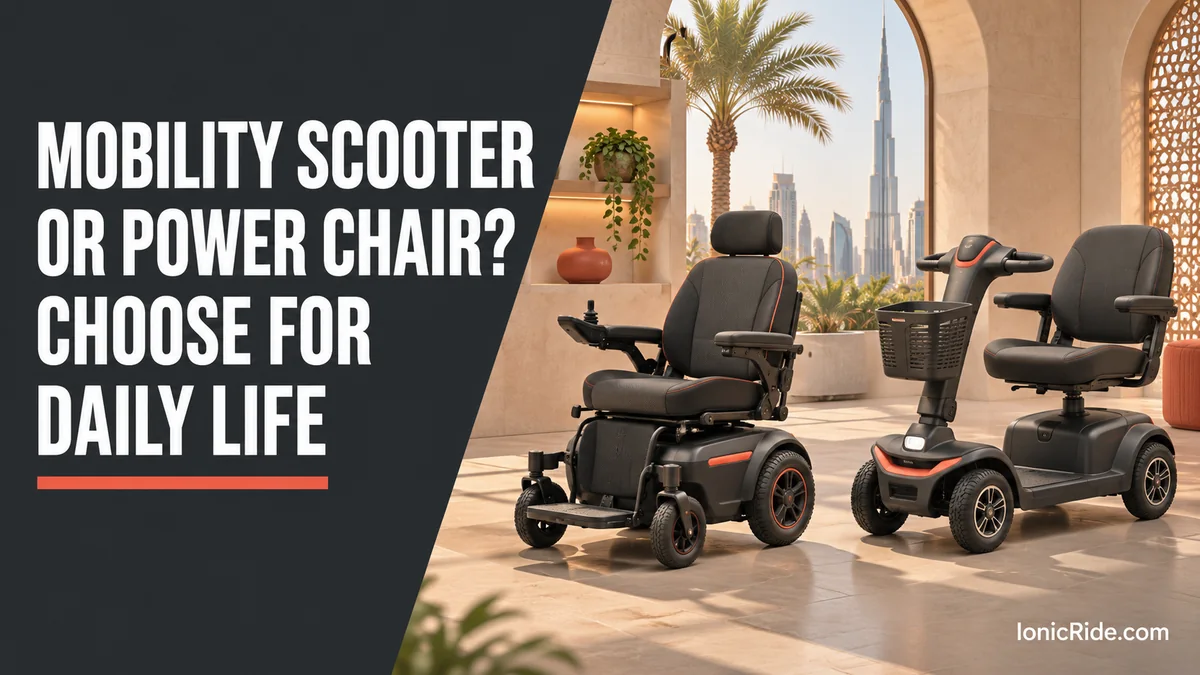
Mobility Scooter vs Electric Wheelchair: Controls, Fit and Daily Use
Quick answer
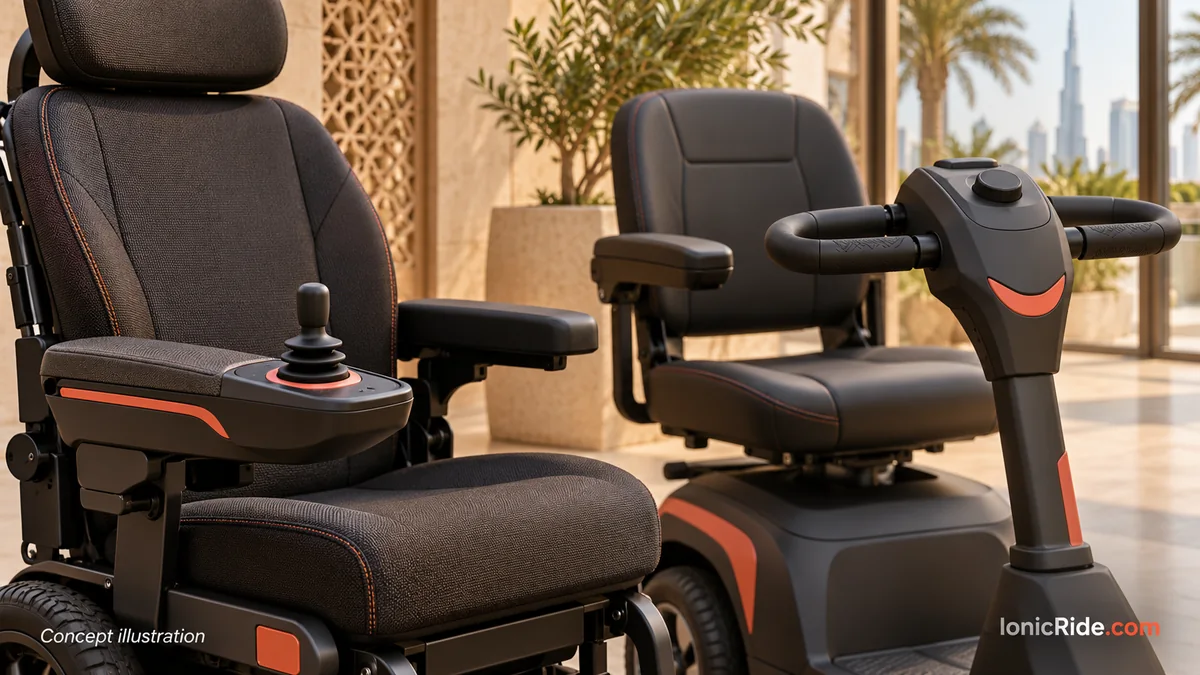
In general, an electric wheelchair uses a joystick and turns more tightly, so it often suits indoor spaces. A mobility scooter uses handlebars called a tiller and often needs more upper-body strength, balance and room to turn. It is commonly used outdoors. These are broad patterns, and models vary. The right choice depends on your body, your spaces and your journeys, so get assessed by an occupational therapist or clinician, and try the device before you buy.
How this guide was made: We read disability organisations’ guidance, manufacturer documents and the UAE Universal Design Code on 3 November 2026. IonicRide is not a medical or rehabilitation provider, and has not tested these devices. This guide does not tell you which device is medically suitable. Age, weight or a symptom alone cannot decide that.
The main differences
| Factor | Electric wheelchair (generally) | Mobility scooter (generally) |
|---|---|---|
| Controls | A joystick, often usable with one hand | A tiller with handlebars, usually needing both arms |
| Turning | Tighter on many models | Wider on many models |
| Body demands | Depends on the seat and controls | Generally more core strength, balance and hand control |
| Seat | Often more support options | Often a swivel seat, for getting on and off |
| Typical setting | Indoors and, on many models, outdoors | Tends to be outdoors |
This table draws on Disability Information Scotland and Pride Mobility, a manufacturer that sells both types. Neither replaces an assessment. For specific models, see our guides to electric wheelchairs and mobility scooters.
Control and support
Ask yourself what you can do comfortably for your whole journey, not just on a good day.
- Arms and hands: can you hold your arms out to steer, and use the controls for a long time? Pride says a joystick can be operated by one hand, and a tiller takes more arm and upper-body strength.
- Sitting: do you need head, trunk or leg support? Ask what each device can be fitted with.
- Attention and vision: a UK council factsheet says the scooter must be entirely in your control, and suggests asking your GP and optician whether you can use one safely.
- Change over time: ask whether your needs may change, and whether the device can be adapted.
Getting on and off
This is often overlooked. Newcastle City Council’s service suggests considering how easily you can transfer. The Middlesbrough factsheet also points out that you must be able to reach the stored scooter, and get on and off it. Swivel seats and folding armrests may help. Test transfers at the height you use at home, including bed, toilet, car and chair.
Measure your spaces
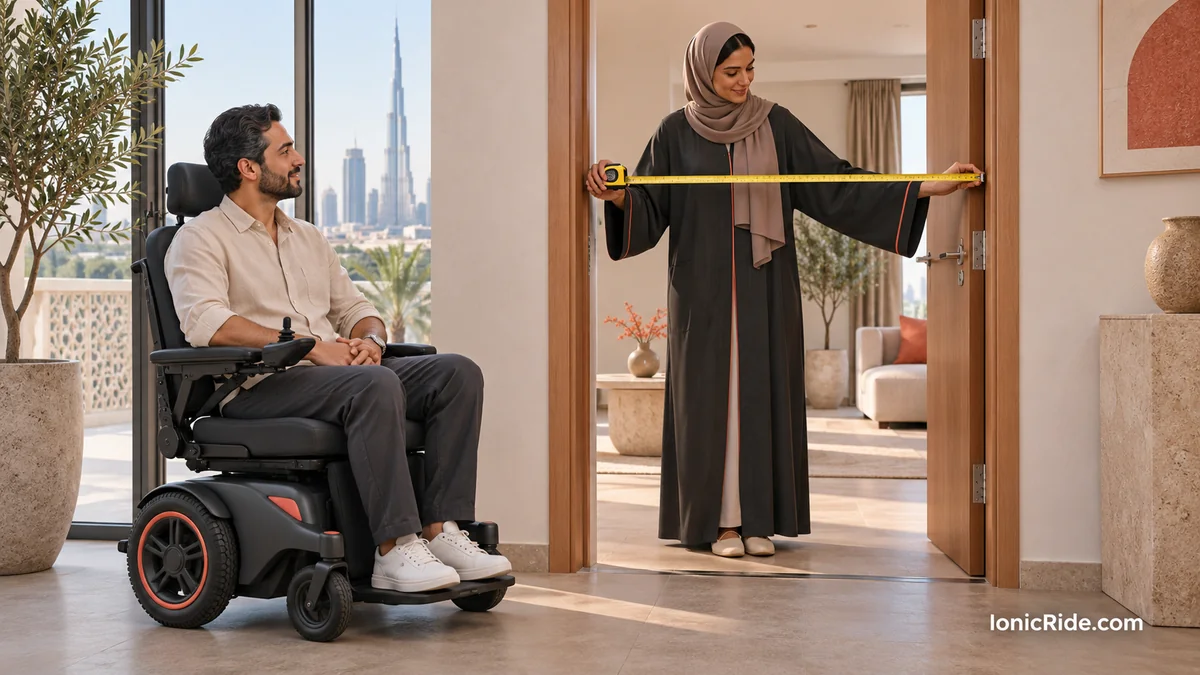
Do not guess from a brochure. Measure the real route, with the device if possible.
| Measure | Compare with | UAE Universal Design Code reference |
|---|---|---|
| Door clear width | Device width, with space for your hands | 900 mm minimum free passage |
| Lift cabin | Device length and width, with room to enter and exit | 1,200 x 1,500 mm minimum for a one-door cabin |
| Turning space | Device’s turning needs, in real rooms | 1,500 mm diameter in accessible toilets; 1,500 x 1,500 mm at lift lobbies |
| Ramps | The device’s stated slope limit | Maximum slope of 8% or 1:12 |
These references come from a published copy of the UAE Universal Design Code. Its definition of “wheelchair” includes powered wheelchairs and mobility scooters. Older buildings may not meet it, and meeting it does not mean your device will fit, so measure.
What manuals show about turning and slopes
These are only examples, from one manufacturer’s documents. They show why you need your own model’s figures.
| Model | Turning radius | Slope limit |
|---|---|---|
| Pride Jazzy Elite ES-1 (wheelchair) | 23.5 in (about 60 cm) | 6° (10.5%) maximum allowable incline |
| Pride Go-Chair (wheelchair, manual copy) | Not recorded | 5° (8.7%) recommended maximum |
| Pride Go Go Elite Traveller 2 (4-wheel scooter) | 37 in (about 94 cm) | Not listed in the brochure |
No slope is safe for every device
Use only your manual’s limit. Pride’s Go-Chair manual warns that steeper slopes may make the chair unstable, even if it can climb them, and warns about tipping when cornering. Your weight, surface and speed all matter too.
Transport and storage
- Car: can it be folded or taken apart, and can you or a helper lift it? The Go Go Elite Traveller 2 separates into 5 pieces, the heaviest at 35 lb (about 16 kg). Heavier models may need a vehicle lift.
- Public transport: do not assume both device types are accepted. Ask the operator about your exact device.
- Storage: Disability Information Scotland warns that some homes may not allow storing or charging a scooter. Ask your building. Keep it dry, and do not block exit routes.
- Charging and heat: see our guide to charging in apartments, and follow your device’s manual. Dubai heat also affects batteries, although that guide is written for e-bikes.
Try it before you buy
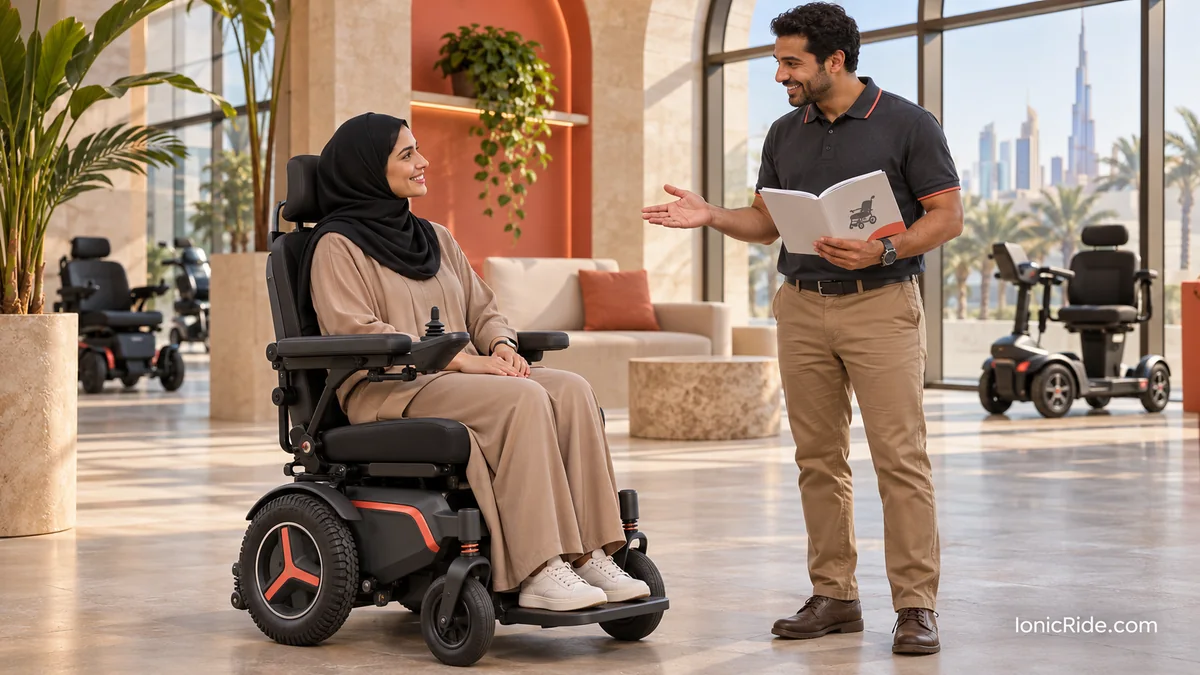
Disability Information Scotland says that only a test drive shows whether a device meets your needs. The Middlesbrough factsheet suggests at least 30 minutes. If you can, test:
- ☐ Your front door, lift, bathroom and regular route
- ☐ Getting on and off, unaided and with a helper
- ☐ Turning and reversing in a tight space
- ☐ The slopes, kerbs and surfaces you really use, with supervision
- ☐ Folding or loading into your car
- ☐ Using it at the end of a long day, when you are tired
Questions for an occupational therapist or clinician
Driving Mobility, a UK charity, says an assessment can cover mobility, medical history, eyesight, seated measurements, comfort, where and how far you will travel, transport, ability to drive the device, and help from carers.
- ☐ Which controls and seating suit my body, now and in the future?
- ☐ Can I safely use a tiller, or do I need a joystick or other controls?
- ☐ Do I need pressure care or postural support?
- ☐ Am I safe to get on and off without help?
- ☐ Do my vision, reactions or medicines affect safe use?
- ☐ What should I measure at home, and can you visit?
Questions for the equipment supplier
- ☐ What are the width, length, turning radius and weight, with the seat and battery fitted?
- ☐ What are the rated user weight and slope limit, in the manual?
- ☐ Can I try it at home, and what is the return policy?
- ☐ What are the warranty terms in the UAE, and who repairs it? How long does a repair take?
- ☐ Are batteries, tyres and controllers available here?
- ☐ Is a loan device available during repair?
- ☐ What are the charger and battery requirements, for use in UAE heat?
FAQs
Which is better for an older person?
Age alone does not decide this. Ask for a functional assessment that looks at strength, balance, vision, transfers and where the device will be used.
Can a mobility scooter go indoors?
Some can, but many need more space to turn. Measure your home, and test it.
Can an electric wheelchair go outdoors?
Many are made for indoor and outdoor use, but limits vary. Check the manual for surface, slope, kerb and weather limits.
Do I need a prescription?
Rules and funding vary. Ask your clinician or provider in the UAE, as this guide cannot confirm your options.
Bottom line
Start with what you need to do and where. Then measure your spaces, get a functional assessment, and try the device. A brochure can help you compare, but it cannot tell you which is right for you.
Related guides
- Dubai public transport with a mobility aid
- Flying with a mobility aid from the UAE
- Electric wheelchair turns on but will not move
Sources
- Disability Information Scotland: choosing a mobility scooter, 2024
- Driving Mobility: mobility scooter and wheelchair assessments
- InformationNOW, Newcastle City Council: wheelchairs and scooters, 2025
- Pride: Go-Chair manual (ManualsLib copy)
- UAE Universal Design Code (hosted copy)
By Alex at IonicRide. Sources checked 3 November 2026.